BroadcastTrucks.com
(775) 220 - 2222

THIS BROADCAST TRUCK IS
FOR SALE
2003 STERLING L9500
EXPANDO SLIDEOUT
Rack Ready, 40 foot
24,000 Original Miles
● 40 Foot - 2003 Sterling, Expanding, Rack-Ready, Live Broadcast Production Truck
● Less Than 24,000 Original Miles!
● Built by Industry-Leader, Shook, in 2003, Original Chassis
● Box is 29'6" x 8' x 11' (Overall Dimensions: 40’L x 13’H x 8’W)
● Motorized Expanding Side with Mechanical Crank Backup
● Expanding Side Adds Approx 4 Feet to Width
● Comfortably Accommodates 10 Seats
• 2 Sets of Entry Stairs, and 3 Entry Doors
• 3 Rooms: Primary Broadcast Room, Engineering Room, Private Audio Room
• Additional Storage Area for Stairs
● Diesel Cat C12, 12L Engine GVWR 53,000 lbs
● Air Ride and Air Brakes, CDL Required
● 200 Amp, Single-Phase Transformer with Floating Neutral
● Currently Wired for 8 Cameras 8 SMPTE or Triax Cameras
● Video and Audio Patching is Intact
● Dual STACO Power Conditioners
● New Tires and Wheels, New Dashboard
● Recent DOT and State Inspections
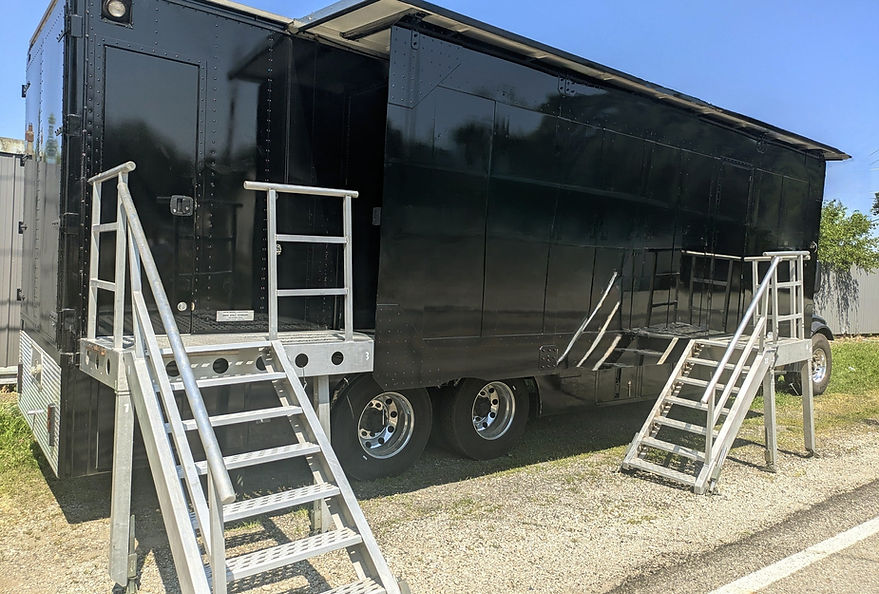
Pictures were taken on uneven ground, so stairs were not level with truck


Why Is This Truck Being Sold ?
I own LiveBroadcast.com and originally acquired this broadcast truck in as part of my investment to produce a motorsports TV show. The plan was to build out a high-end, 40-camera live broadcast mobile production studio. The show never materialized and the business relationship didn’t pan out — but this truck is an absolute gem.
It was selected for its size, layout, and scalability. Whether you’re producing live sports, concerts, corporate events, or streaming multi-camera broadcasts, this unit was built to be the backbone of a serious, professional-grade operation. It's ready for customization, and with the right buildout, it has the potential to rival trucks ten times the price.
While I’m no longer pursuing the project myself, this is a rare opportunity for someone with vision and the right team to capitalize on a serious piece of production infrastructure.
History of This Truck
We acquired it from Michael Skehan, a veteran broadcaster in Washington D.C. who has worked closely with the White House and nearly every President since the Carter administration. Skehan purchased the truck from a major studio in Los Angeles and drove it back to his headquarters D.C., intending to do another full buildout. Ultimately, he decided it was too late in his career to take on another major buildout, as he was beginning to wind things down.
The key takeaway is: this truck came from one of the most respected live broadcast professionals in the United States. Mike knew exactly what he was looking for and chose this vehicle for a reason. It was his alongside other top-tier trucks at his large D.C.-area facility, where it was meticulously maintained.
After purchasing the truck, I hired a professional driver and personally met him in D.C. We brought it to Circleville, Ohio—about 45 minutes outside of Columbus—for additional work, including a stunning, brand-new black paint job.
The truck is currently stored in a secured lot at the paint shop outside Columbus, Ohio. They’ll be happy to show it to you in person and can take you on a test drive if you travel there. Between acquiring this rig from industry veteran Michael Skehan and my own 30 years in the video production world, I can confidently say this truck is as good as it gets anywhere near this price point. It drives flawlessly, is in top-tier condition, has been well-maintained, and has exceptionally low mileage. If needed, I can also arrange nationwide delivery through my trusted driver once the sale is complete.
You will not find anything even close to this caliber of truck for anywhere near this price.
Over $50,000 of improvements have recently been invested into this broadcast truck.
Below is an overview of the expenses, with a more detailed PDF link here ---------------->>>
Payee
(1) LA Fleet Care
(2) US Tire
(3) 4 State Trucks
(4) SP Dashdesign
(5) K Neal Truck & Bus Center - Maintenance Shop
(6) K Neal Truck & Bus Center - Body Shop
(7) Rolltechs Specialty Vehicles, LLC
(8) Paul's Roadside Service
(9) Misc. Ancillary Gear/Accessories/Material, etc.
(10) Misc. Ancillary Gear/Accessories/Material, etc.
Sub-Total
New Black Paint Job
(11) Paint / Mirrors
GRAND TOTAL:
Amount
$ 8,552.95
$ 4,409.60
$ 261.85
$ 2,700.00
$ 2,517.25
$ 13,939.54
$ 884.50
$ 900.00
$ 275.81
$ 40.73
$ 34,482.23
Amount
$ 18,475.00
$ 52,957.00
Expense Description
(1) Misc. Truck Repairs/Maintenance Service
(2) Tires & Wheels
(3) Exhaust Pipe
(4) Dash
(5) Shocks, Rear Wheel Seal/Gasket and Batteries
Install front wheels, Exhaust Pipe and Dash
(6) Partial Sand & Paint, Misc. Repairs
(7) 2 Motor Assemblies & Worm Gears
(8) Installation/Replace Motor & Worm Gear
(9) Rear/Tail Lights
(10) Levels & Circuit Breaker
Expense Description
(11) Sand and prep entire vehicle, removal of old mirrors,
bondo holes from old mirrors, paint entire vehicle and
slideout, install new mirrors
General Information
Read all safety and operating instructions, including this manual, and follow these instructions while operating the equipment. All of the instructions and manuals should be stored in a convenient place for future reference.
Vehicle Operations
While driving the vehicle, pay special attention to lower bridges, garage doors, power lines, and any low
clearance areas.
Height Restrictions:
Top of vehicle - 12 Feel 10 inches / 3.91 Meters
Recommend Minimum Clearance = 13 Feet 2 Inches / 4.06 Meters
This vehicle is equipped with a 21ft-slide-out wall on its curbside. The vehicle is to be leveled before the slide- out wall is opened. A minimum distance of 52 inches is needed to open the slide-out wall.
Power System Operations
All AG powered equipment comes with a 3-wire plug with an integral grounding pin. This plug fits into the standard, grounded power outlets in the vehicle. Do not defeat the safety purpose of the grounded plugs. This is a dangerous shock hazard and can seriously harm or even kill personnel.
-
vehicle and the operators. Improper vehicle powering could cause extensive damage. See the "POWER SYSTEMS" section for powering the vehicle correctly.
Equipment Operations
The compressor on the air conditioner may be damaged if the unit is turned off and then back on again without allowing enough lime lor the head pressure to stabilize. Operators should wait al least five minutes before attempting to turn the air conditioner back on.
The air conditioner has been modified with a "Hot Gas Bypass" Any service person attempting to work on this unit must be notified of this modification.
The air conditioner should be operating any time the vehicle and the electronic equipment within it are powered, even il air conditioning or heating is not desired. The goal is to keep airflow around the electronic equipment at all times.
POWER SYSTEMS
The A-29 EXP vehicle is equipped with a complete power system that includes both AG and DC power. This power system is fed by an external “Shore" power source. A power distribution diagram has been provided in Appendix-A.
AC Power Systems
The vehicle is equipped with an AC power system that operates equipment at 190 VAC and 277 VAC at 60Hz. The source of the power comes from tying the vehicle to a city (exterior) power supply. The power has been split into two systems, one utility, and one technical. The utility power system powers the heavy power consuming devices including the air conditioner. The technical system is used to power all of the equipment racks and AC outlets.
Technical Power and the STABILINE Regulators
The Technical Power System has the added advantage of running through STABILINE automatic voltage regulators. These are to maintain a stable AC voltage. These regulators are not surge protectors. They are electronically controlled rheostats used to set stable output voltages over long-term operations. They are located in the bottom of racks 7 and 8 in the rear of the truck. See the STABILINE instruction manual lor further details.
The AC powers 's distributed at the distribution panel as follows:
Technical System Utility System
Racks 1 through 18 Curb Side Air Conditioner 220 VAG
Over- Head Racks 1-4 Street Side Air Conditioner 220 VAC
Kibitz Lights
Speakers Converter/Charger
Wall Outlets
Switcher Power Supply 220 VAG
Powering from City Power
Located on the power control panel: The Utility breakers, Technical breakers, volt
/amp/frequency meter with leg switch, Air conditioner thermostats, battery voltmeter.
The rear curbside belly box contains; the power input connectors, exterior light switches, Iap switch, power input voltmeter, main breaker, and converter/charger with DC
us box.
-
City power is connected through the rear curbside control panel. Power input required is 190-vac to 277- vac. The main breaker is rated at 200 amps. Input power should not exceed that limit.
Be sure the main breaker, located on the shore power input panel, is oft before connection of primary power to the vehicle.
-
Check the primary power with a portable voltmeter at its source BEFORE connecting the power cable to the input power connector of the vehicle. Input power of greater than 277-vac can damage the equipment in the vehicle so measure input power before connecting to vehicle.
4 Set the power "TAP" switch, on the power panel, lo the settling that matches the input voltage being applied to the vehicle. Input source voltages of 190-vac, 208-vac, 220 vac, 230-vac, and 240-vac and 277-vac are accepted. Shook recommends that the vehicle should be powered by a 208-vac lo 230-vac for optimum efficiency.
WARNING: ft the input tap switch is in the 190-vac position and voltages higher are applied to the system, isolation transformer damage is possible and even likely at the higher voltages.
-
Connect the input power cable to the vehicle.
NOTE: The power input cables must be connected in the following order and reverse order for removal: Conductor 1 Black
Conductor 2 - White
Ground Green
NOTE: It is not necessary to hook up the (green) ground wire unless required to do so by local codes. II the (green) ground wire is connected, even though the isolation transformer is still in the circuit, its usefulness as isolation from ground induced noise and hum is effectively bypassed. In fact, it is possible that ground loops could easily be introduced into the system.
-
Only after all the above steps have been completed, turn the main breaker on. Check the digital voltmeter, on the power panel, and read the voltage. Verify that it is reading close to 120 vac.
NOTE: This voltmeter is reading the output of the isolation transformer, not the input power to the vehicle.
-
Turn on the air conditioner breakers and allow it to stabilize (when you hear the compressor kick in).
-
Turn on the breakers in the breaker panel. Allow the equipment to power up and stabilize.
-
Place all the technical (TV) equipment into the mode in which you wish il to warm up lor operation.
DC Power Systems
Two batteries and an AC lo DC converter charger power the DC systems of this vehicle. The batteries are located under the passenger's side door of the cab. The converter is located in the rear curbside belly box and the DC fuses are on the power control panel just inside the main door. The utility power panel supplies AC power lor the converter.
Caution should be taken that all DC lighting is used for just a short time when the production vehicle is not in operation. If long periods of DC lighting are needed, the vehicle and the DC converter should be powered to operate the lighting. This converter leads the following circuits:
Breakers
40 amp resetting breaker — Slide out Wall Drive
Fuses
-
50 amp
-
30 amp
-
20 amp
-
20 amp
-
10 amp
-
Spare
Battery Charger Belly Box Lights
Street Side Work Lights Curbside Work Lights Pod Lights